


Emergency and exit lights UAE buildings are required to have are one of those fire safety elements that most people never think about until the power goes out or a fire alarm sounds. In that moment they become the single most important thing in the building — guiding everyone safely toward the nearest exit through smoke, darkness and panic.
If you own or manage a commercial building in UAE whether in Abu Dhabi, Dubai or Sharjah — understanding what emergency and exit lights are legally required, where they must be placed and how they must be maintained is not optional. It is part of your compliance obligation under UAE Civil Defense regulations.
What Emergency and Exit Lights UAE Buildings Are Required to Have
Emergency and exit lights UAE Civil Defense requires for commercial buildings are not the same thing — though many building owners use the terms interchangeably. Understanding the difference matters because both are required and both serve a different purpose.
Exit lights are signs — illuminated signs that clearly show occupants the location of every emergency exit in the building. They must be visible at all times, including during a power failure, which means they run on a dedicated backup power supply that activates automatically when the main power is cut.
Emergency lights are luminaires — actual light fittings that provide illumination in corridors, stairwells, escape routes and any other area that people need to navigate during an evacuation. Without emergency lighting a corridor that is perfectly lit during normal operations becomes a dark, disorienting obstacle during a fire or power failure.
Under UAE Civil Defense requirements and NFPA 101 — the Life Safety Code — all commercial buildings must have both exit signs and emergency lighting installed along every escape route, at every exit door, in every stairwell and in any area where the loss of normal lighting would create a safety risk.
Where Emergency and Exit Lights Must Be Placed in UAE Buildings
Correct placement of emergency and exit lights UAE buildings require is where a lot of commercial properties fall short during Civil Defense inspection. Having the lights is not enough — they need to be in the right locations to actually guide people safely out of the building.
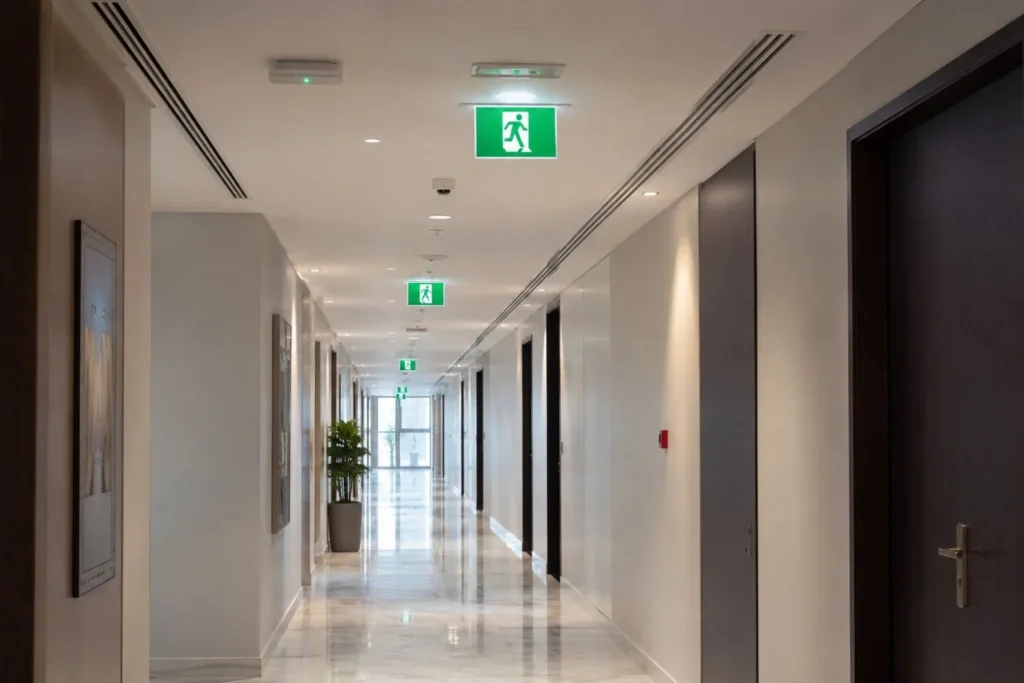
Exit signs must be placed directly above or adjacent to every emergency exit door. They must also be placed at every point along an escape route where a person could reasonably be unsure which direction to go — corridor junctions, stairwell landings and any turn in an escape route. The sign must be visible from both directions of approach.
Emergency lighting is really important. It has to give off light all along every escape route.This means that people can see where they are going and get out safely. Emergency lighting is necessary on every floor of a stairwell. This is so people can see the stairs and landings and do not trip or get hurt when they are trying to get out of a building during an emergency. Emergency lighting must be, on every landing of the stairwells. Plant rooms, electrical rooms, generator rooms and any occupied space without natural light also require emergency lighting coverage.
Special Placement Requirements for High Rise Buildings
High rise buildings in UAE have additional emergency and exit lights UAE requirements because of the time it takes to evacuate multiple floors. Every floor needs its own dedicated emergency lighting coverage, stairwells must be lit from top to bottom without gaps and refuge areas — where occupants may wait during a phased evacuation — must also be properly illuminated and signed.
Car Parks and Basement Areas
Car parks and basement areas in UAE commercial buildings are often overlooked when it comes to emergency and exit lights UAE coverage. These areas have no natural light at all which makes emergency lighting particularly critical. Every level of a car park needs emergency lighting along driving lanes and pedestrian walkways, with exit signs clearly visible from every area.
Emergency and Exit Lights UAE — Battery and Testing Requirements
Emergency and exit lights UAE Civil Defense inspectors check during inspections are not just assessed on whether they are present in the right locations. The backup battery system that powers these lights during a power failure is checked just as rigorously as the fixtures themselves.
Under UAE Civil Defense and NFPA 101 requirements emergency lighting must be capable of operating for a minimum of 90 minutes on battery power alone. This gives building occupants enough time to evacuate safely even in a prolonged power outage or fire event.
The batteries that are inside the emergency lighting units will get worse over time. This happens when the emergency lighting units are never actually used. The batteries, in these emergency lighting units will still degrade. A unit that was fully functional three years ago may no longer hold a 90 minute charge today. This is why regular testing and maintenance is not just good practice — it is a legal requirement.
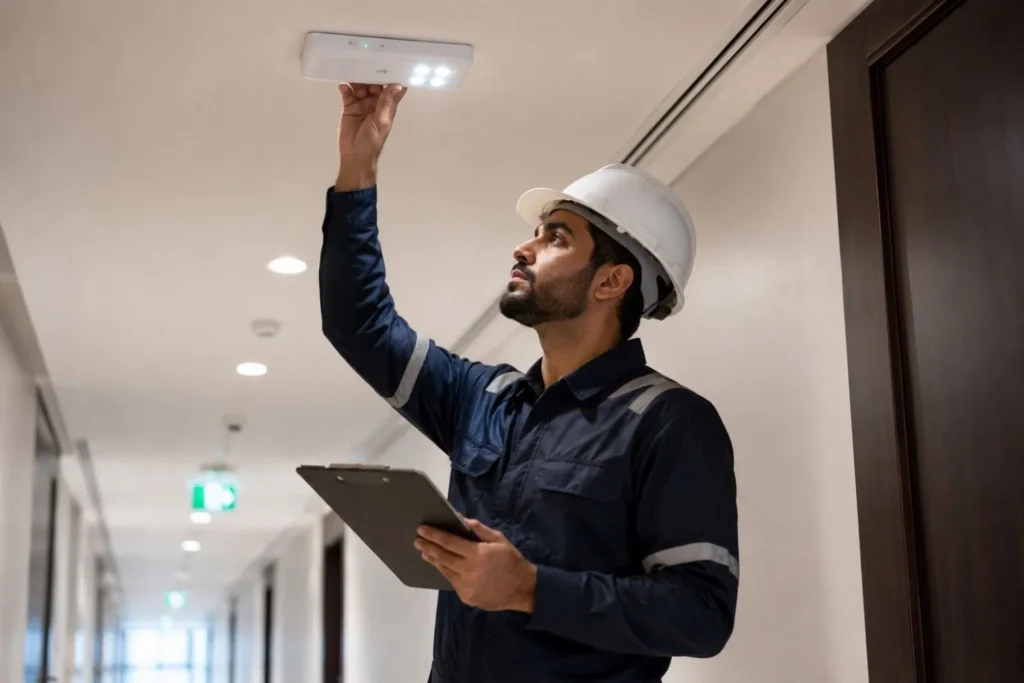
Every emergency lighting unit must be tested monthly with a short function test to confirm the battery activates and the light works. An annual full duration test — where the unit runs on battery power for the full 90 minutes — must also be carried out and documented. These test results must be available for Civil Defense inspectors when they visit.
Common Emergency and Exit Light Failures During UAE Civil Defense Inspections
Many commercial buildings in UAE invest in installing emergency and exit lights but still fail inspection because of issues that could have been caught with regular maintenance. Here are the most common failures inspectors find:
Burned out bulbs or LEDs in exit signs that have not been replaced — the sign is present but not actually visible in an emergency. Battery units that no longer hold a charge because they were never tested or the batteries were never replaced. Exit signs pointing in the wrong direction after a building renovation changed the layout of escape routes. Emergency lights that were installed at the wrong height or obscured by signage, shelving or partitions added after the original installation. No maintenance records available to show testing has been carried out as required.
Every one of these failures is avoidable with a proper maintenance programme and a commitment to checking the system regularly rather than assuming it is fine because it has never been needed.
Conclusion
Emergency and exit lights UAE commercial buildings depend on are not a minor compliance detail. They are the system that guides your employees, customers and visitors safely out of your building when everything else has gone wrong — when the power is out, the smoke is building and the alarm is sounding.
Getting the type, placement and maintenance right from the start protects people and keeps your building compliant with UAE Civil Defense requirements. Whether your building is in Abu Dhabi, Dubai, Sharjah or Qatar, a qualified and Civil Defense approved fire safety contractor can make sure your emergency and exit lighting is exactly where it needs to be and working exactly as it should.