


Fire detection systems UAE buildings depend on are the first line of defense against fire. Before a sprinkler activates, before the firefighting team arrives, before anyone can evacuate safely — a fire detection system is what identifies the problem and triggers the response. Getting the right type of fire detection system installed correctly in your building is not just a compliance requirement under UAE Civil Defense regulations. It is the decision that gives everyone inside the building the best possible chance of getting out safely.
This guide covers the main types of fire detection systems UAE buildings use, where each type is most appropriate and what UAE Civil Defense requires.
Why Fire Detection Systems in UAE Are More Than Just Smoke Detectors
When most people think about fire detection systems UAE buildings have installed they picture a smoke detector on the ceiling. The reality is that modern fire detection in UAE commercial, industrial and residential buildings is far more sophisticated than a single device.
A complete fire detection system UAE Civil Defense approves is an integrated network of detection devices, a central control panel, manual call points and output devices — all working together to identify the presence of fire at the earliest possible stage and communicate that information to building occupants and emergency services simultaneously.
The type of detection devices used, how they are connected and how the system is configured depends entirely on the building — its size, its use, what is stored or produced inside it and what the specific fire risks are. A single office floor and a large petrochemical facility in UAE both need fire detection systems — but they need completely different ones.
Types of Fire Detection Systems UAE Buildings Use
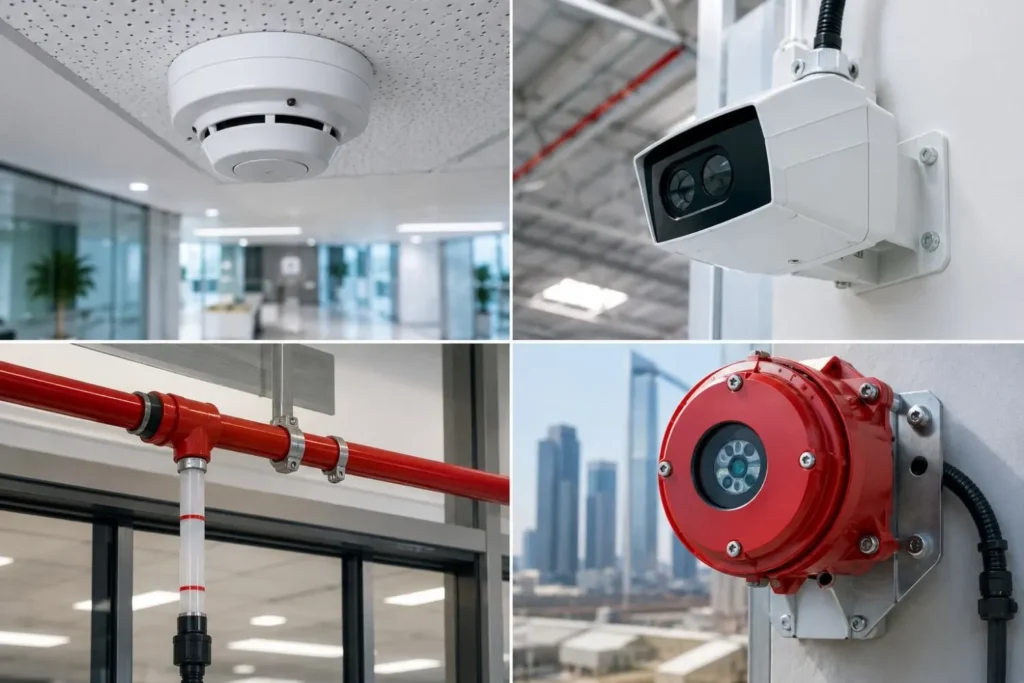
Conventional Fire Detection Systems
Conventional fire detection systems UAE buildings of a smaller size typically use divide the building into detection zones. Each zone connects to the control panel and when a detector in that zone activates the panel shows which zone has triggered — but not which specific device.
This works well for straightforward buildings with a limited number of rooms and floors. Small offices, retail units, warehouses with simple layouts and smaller residential buildings across UAE commonly use conventional fire detection systems because they are cost effective and straightforward to install and maintain.
The limitation is that in a large or complex building a zone covering multiple rooms or an entire floor does not give you enough information to locate the fire quickly. This is where addressable systems become necessary.
Addressable Fire Detection Systems
Addressable fire detection systems UAE large commercial buildings, hotels, hospitals, high rise towers and complex industrial facilities depend on give every single detection device its own unique address. When any detector or call point activates the control panel identifies not just the zone but the exact device — telling you precisely where in the building the alarm has come from.
This precision makes a significant difference in how quickly building management and emergency services can respond. In a building with hundreds of rooms across multiple floors knowing the fire is on the third floor east corridor is far more useful than knowing it is somewhere on floors two to five.
Addressable fire detection systems UAE Civil Defense requires for most large commercial developments are also capable of integrating with other building systems — HVAC, access control, lifts and sprinklers — creating a coordinated building-wide response to a fire event.
Wireless Fire Detection Systems
Wireless fire detection systems UAE buildings undergoing renovation or buildings where running cables is not practical use radio frequency signals to connect detectors and devices to the control panel rather than physical wiring. They are particularly useful in heritage buildings, temporary structures and buildings that cannot be easily rewired without significant structural disruption.
Wireless fire detection systems UAE contractors install require more frequent battery maintenance than wired systems but are just as reliable when properly serviced. They are increasingly common in Qatar for the same reasons — older buildings in Doha’s heritage areas where cabling is restricted.
Aspirating Smoke Detection Systems
Aspirating smoke detection systems — also known as ASD or air sampling systems — are the most sensitive type of fire detection available. Instead of waiting for smoke to reach a detector mounted on the ceiling these systems actively draw air samples from the protected space through a network of sampling pipes and analyse them continuously for the earliest traces of smoke.
ASD systems can detect smoke at concentrations far below what any standard detector can sense — giving building managers minutes of advance warning before a fire has developed enough to be visible or to trigger conventional detectors.
Fire detection systems UAE data centers, server rooms, museums, archival storage facilities, clean rooms and telecommunications infrastructure commonly use ASD systems because in these environments catching a fire in its absolute earliest stage — when it is still a slow smouldering heat source — can prevent total loss of irreplaceable equipment or data.
Beam Detectors
Beam detectors are a specialized type of fire detection device used in large open spaces where installing individual point detectors across a wide area would be impractical or insufficient. They work by projecting an infrared beam across the space — when smoke interrupts the beam the system triggers an alarm.
Fire detection systems UAE warehouses, aircraft hangars, large industrial facilities, sports halls and atrium spaces in high rise buildings in Abu Dhabi and Dubai use beam detectors to provide coverage across areas where standard ceiling mounted detectors would either be too far from the floor to detect smoke effectively or would require an impractical number of devices.
Flame Detectors
Flame detectors respond directly to the radiation produced by a fire rather than to smoke or heat. They are used in environments where conventional smoke detection would be triggered by normal operational conditions — welding areas, chemical processing plants, fuel storage facilities and open industrial environments where dust, steam or fumes are present during normal operation.
Fire detection systems UAE industrial zones in Abu Dhabi, Dubai and Sharjah that handle flammable liquids, gases or involve open flame processes commonly incorporate flame detectors as part of a layered detection approach.
Fire Detection Systems UAE Civil Defense Requirements
UAE Civil Defense requirements for fire detection systems are based primarily on NFPA 72 — the National Fire Alarm and Signaling Code — alongside the UAE Fire and Life Safety Code of Practice.
Every fire detection system UAE buildings install must be designed by a qualified engineer and submitted to UAE Civil Defense for design approval before installation begins. Only Civil Defense approved contractors are authorized to carry out the installation. After installation the complete system must be tested and commissioned and the results documented before the building can be certified.
An Annual Maintenance Contract with a UAE Civil Defense approved fire safety contractor is required after installation. All maintenance visits must be documented and records must be available for Civil Defense inspectors at any time.
The specific type of detection system required — conventional, addressable, wireless or specialist — depends on the building classification assigned by UAE Civil Defense based on the building’s occupancy type, size and risk level. Getting this classification right from the start is essential because installing the wrong type of system for a building’s classification will result in a failed Civil Defense inspection even if the system itself is fully functional.

Fire Detection Systems UAE — Choosing the Right Contractor
Choosing the right contractor to design and install fire detection systems UAE buildings need is just as important as choosing the right type of system. A fire detection system designed by engineers without the right qualifications and installed by a contractor without UAE Civil Defense approval is not compliant — regardless of what equipment was used.
Before engaging any contractor for fire detection systems UAE wide confirm the following. The contractor must be officially approved by UAE Civil Defense at the appropriate grade — Grade A covers all project types. The engineering team must include NFPA certified engineers who understand both international standards and UAE-specific requirements. The contractor must have a proven track record of completing and handing over fire detection projects to UAE Civil Defense across Abu Dhabi, Dubai and Qatar. They must offer an Annual Maintenance Contract after installation and be capable of providing emergency response for system faults.
Conclusion
Fire detection systems UAE commercial, industrial and residential buildings depend on are not a commodity product where any system will do. The right type of system for your building, designed correctly, installed by an approved contractor and maintained consistently throughout the year is what provides genuine protection — not just compliance on paper.
Whether your building is in Abu Dhabi, Dubai, Sharjah or Qatar understanding which type of fire detection system your building needs and what UAE Civil Defense requires is the foundation of a fire safety strategy that actually works when it matters.