


Choosing the right fire protection company Qatar is one of the most important decisions any building owner or business manager in Doha will make. Qatar has one of the fastest growing commercial real estate markets in the Middle East and with that growth comes an increasing responsibility to make sure every building is properly protected and fully compliant with Qatar Civil Defense Department regulations.
The challenge is that not every company calling itself a fire protection company Qatar is genuinely qualified. Some are approved by QCDD. Some are not. And the difference between working with the right company and the wrong one can affect your building certification, your insurance coverage and most importantly the safety of everyone inside.
This guide covers what a fire protection company Qatar is responsible for, what QCDD requires and exactly what to check before you hire anyone.
What Does a Fire Protection Company in Qatar Actually Do
A fire protection company Qatar handles the complete lifecycle of fire safety for your building. This is not just about supplying equipment — it covers the full process from initial design and QCDD submission through to installation, commissioning, handover and ongoing annual maintenance.
The core services a qualified fire protection company Qatar provides include fire alarm system design and installation, firefighting system supply and installation including wet riser, dry riser and hose reel systems, fire hydrant networks, sprinkler systems, FM200 clean agent suppression for server rooms and data centers, wet chemical kitchen hood suppression for commercial kitchens, emergency and exit lighting and Annual Maintenance Contracts for all installed systems.
A fire protection company Qatar that handles everything under one roof gives building owners a point of accountability. When everything is managed by one approved contractor nothing gets missed between different vendors and your QCDD compliance is consistent across every system in the building.
What QCDD Requires From Every Fire Protection Company in Qatar
The fire protection companies that work in Qatar must follow rules set by the Qatar Civil Defense Department. Knowing these rules helps people who own buildings make choices of just believing everything a company says.
Every fire protection company Qatar must be officially approved by QCDD before they can legally design, install or maintain fire protection systems. This approval is not automatic — companies must demonstrate that they have qualified engineers, that they use QCDD approved materials and equipment and that they have a documented track record of completing and handing over fire protection projects in Qatar.
All fire protection system designs must be submitted to QCDD for approval before any installation begins. The completed installation must be fully tested and commissioned before the building can be handed over or occupied. All maintenance must be carried out under a valid Annual Maintenance Contract with a QCDD approved fire protection company. Every maintenance visit must be documented and records must be available for QCDD inspectors at any time.
Buildings in Qatar that work with unapproved fire protection companies face serious consequences — failed inspections, rejected completion certificates and in serious cases forced shutdowns until systems are brought into compliance by an approved contractor.
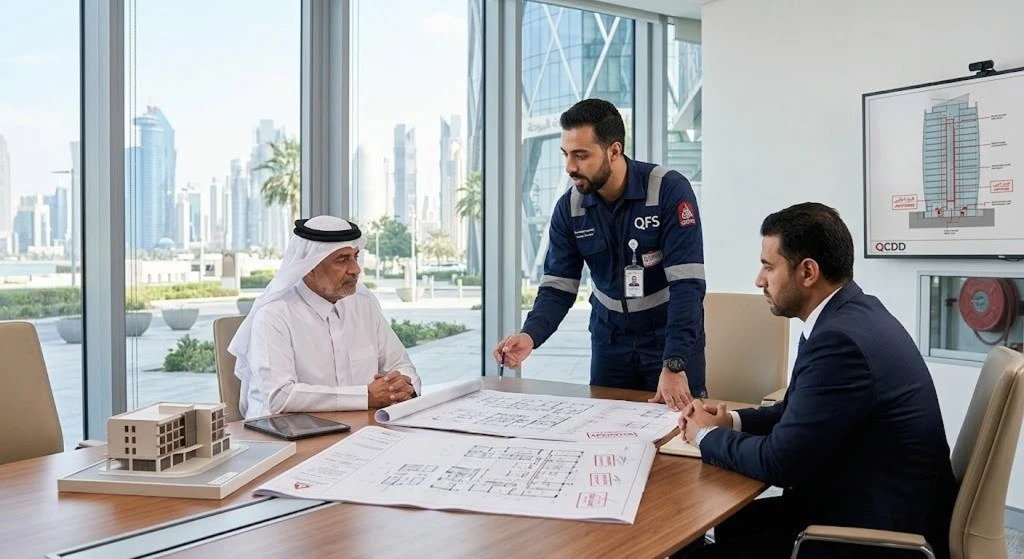
Fire Protection Systems Qatar Buildings Need
Different buildings in Qatar have fire protection. The right combination of fire protection systems depends on the building type, how many people use it and the specific fire risks.
Commercial Office Buildings
Office buildings across Doha need at minimum a complete fire alarm system, sprinkler coverage, emergency and exit lighting and fire extinguishers in the correct type and quantity for each area. Larger office towers also need wet riser systems and fire hydrant points. A qualified fire protection company Qatar designs all of these systems to work together rather than installing them independently.
Hotels and Hospitality Buildings
Qatar’s hospitality sector is one of the most demanding environments for fire protection. Hotels need advanced fire alarm systems with voice evacuation capability, comprehensive sprinkler coverage, kitchen hood suppression for all food preparation areas and emergency lighting throughout every floor and stairwell. The fire protection company Qatar that handles a hotel project needs specific hospitality experience — the requirements are more complex than standard commercial buildings.
Warehouses and Industrial Facilities
Industrial facilities and warehouses in Qatar’s industrial zones need fire protection systems designed for high risk environments. High density sprinkler systems, foam suppression for areas storing flammable liquids, deluge systems for high risk processing areas and dedicated firefighting access routes are standard requirements. A fire protection company Qatar working on industrial projects must have Grade A QCDD approval and proven industrial experience.
Server Rooms and Data Centers
Qatar’s rapidly growing technology infrastructure means more data centers and server rooms than ever before. These environments cannot use water based suppression systems without risking catastrophic damage to equipment. FM200 clean agent suppression is the standard solution — and the fire protection company Qatar installing it must have engineers with specialist knowledge of clean agent system design and room integrity testing requirements.
How to Choose the Right Fire Protection Company in Qatar
Before signing any agreement with a fire protection company Qatar confirm the following:
Ask for the company’s official QCDD approval certificate and check the approval grade. Grade A covers all project types and sizes — lower grades have restrictions on what they can work on. Ask whether the company has NFPA certified engineers. This confirms the engineering team works to international standards as well as local QCDD requirements.
Ask for references from fire protection projects completed and handed over to QCDD in Qatar specifically — not just UAE or other GCC countries. Confirm the company handles the full QCDD design submission and approval process rather than leaving it to the building owner to manage. Make sure the company offers a comprehensive Annual Maintenance Contract after installation with documented maintenance visits. Ask about emergency response times for system faults outside of scheduled maintenance — a professional fire protection company Qatar should commit to a clear response timeframe.
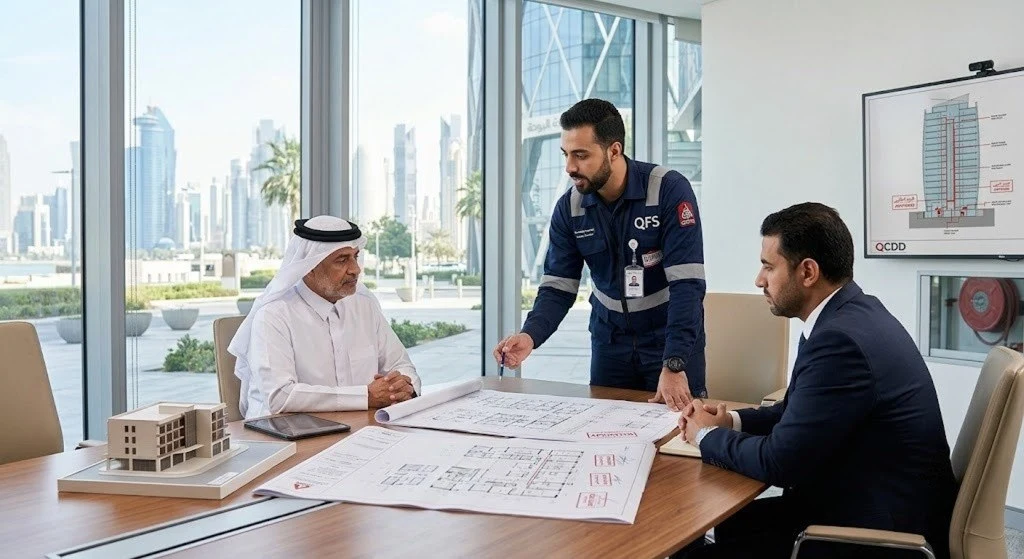
Fire Protection in Qatar Versus UAE — Why They Are Different
A common mistake building owners make is assuming that a fire protection company with strong UAE experience automatically understands Qatar requirements. While the two markets share some similarities they operate under different regulatory frameworks with different approval processes, different submission requirements and different inspection expectations.
QCDD — the Qatar Civil Defense Department — operates independently from UAE Civil Defense authorities.Approval that is granted in Abu Dhabi or in Dubai is not automatically valid in Qatar. The specific codes and standards Qatar applies, the documentation format QCDD inspectors expect and the handover process for new buildings all differ from UAE practice.
This is why it is essential to work with a fire protection company in Qatar that has direct QCDD approval and a track record of completing projects in Qatar — not just a company that has adapted its UAE experience and hopes it transfers across.
Conclusion
A fire protection company in Qatar that is genuinely qualified — QCDD approved, NFPA certified and experienced in the Qatar market — is not just a contractor. They are a long term partner who keeps your building safe keeps your occupants protected and keeps your compliance standing.
Whether your building is in West Bay or the Pearl or Al Wakrah or Al Khor or anywhere else, across Qatar choosing the fire protection company from the beginning saves time and money and the serious stress that comes from discovering compliance problems during a QCDD inspection.